New reports demonstrate clear economic benefits from net zero transition since Paris Agreement
Mon 27 October 2025
View all news
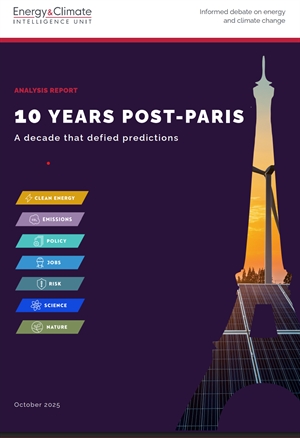
A new report from the Energy & Climate Intelligence Unit (ECIU) shows how in the decade since the Paris Agreement, the economic case for the decarbonisation transition has become not just an an environmental imperative but a source of clear economic benefit. Meanwhile, a separate report University College London finds that the development of wind power in the UK, from 2010 to 2023, delivered a net benefit of £104.3 billion to UK consumers.
ECIU's report is entitled: '10 Years Post-Paris: A decade that defied predictions' shows dramatic progress in clean energy deployment, emissions moderation and job creation. It finds that renewables met 67% of global electricity demand growth in the decade after 2015; a remarkable shift from the prior period when fossil fuels met 68 % of demand growth.
The report says that clean energy investment is expected to reach US $2.2 trillion in 2025, doubling fossil fuel investment and demonstrating private sector confidence in the low carbon economy. Significantly, jobs in clean energy (36.2 million) now exceed jobs in oil, gas and coal (32.1 million) worldwide.
This demonstrates how the transition drives economic activity, employment and investment flows.
A recently published study by University College London researchers which models the long-term financial benefits of UK investment in wind energy generation provides a striking case study in the UK context. They estimate that wind power, from 2010 to 2023, delivered a net benefit of £104.3 billion to UK consumers -broken down as about £14.2 billion in lower electricity prices and approximately £133.3 billion from reduced natural gas prices, partially offset by £43.2 billion in wind subsidy costs. The authors argue that wind investment should be seen not as a costly burden but as “a compelling financial investment”.
Together these reports highlight that large economic benefits flow from the net zero transition.
The ECIU report notes that global CO₂ emissions growth slowed from 1.7% pa before Paris to 0.32% pa since, underscoring the structural change in energy systems. It demonstrates that clean energy technologies are scaling rapidly; for example, global solar installations in 2024 exceeded 553 GW and have doubled every three years.
The implications are clear: policies aimed at the net zero transition can yield economic dividends alongside climate benefits. Rather than viewing decarbonisation as a cost alone, these findings can help to reframe the narrative - clean energy investments are also an engine for growth, jobs and savings.
However, the reports caution that the benefits from the transition are unevenly distributed. These depend on the existence of robust policy frameworks, stable investment signals and a fair distribution of the gains. The ECIU report specifically calls for scaling finance and technology flows especially into developing economies.
The two recent reports are clear that the net zero transition is already delivering measurable economic pay-offs in multiple ways: through cost savings, job creation, investment attraction and enhanced energy security. With the right policy settings, it says, these benefits will accrue more broadly and deepen over time.
Related Links
< Back to news list