Falling battery and manufacturing costs driving truck sector to key tipping points near2030 - report
Thu 27 August 2026
View all news
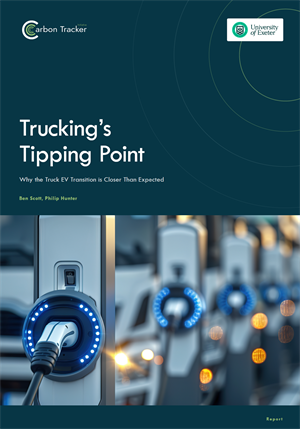
A new report from Carbon Tracker finds that falling battery costs, manufacturing scale and improving operating economics are bringing battery-electric trucks towards total cost of ownership (TCO) parity with diesel across major markets, with key tipping points expected by the early 2030s. A separate report from Transport & Environment says that in six out of nine major EU markets, electric trucks are already cheaper on a TCO basis.
The Carbon Tracker report says that once cost parity is reached, uptake can be rapid, rather than gradual, accelerating along a non-linear S-curve, creating transition risks for manufacturers with large exposures to internal combustion technology and opportunities for companies better positioned for an increasingly electric market.
China's experience shows how quickly market share can shift once the economics becomes favourable; in 2025 around 30% of around a million trucks sold were battery electric, up from 1% in 2021.
The report's key findings are that:
Heavy-duty freight could electrify sooner than consensus assumptions suggest.
Total cost of ownership, rather than regulation alone, will determine the pace of the transition. Battery-electric trucks are expected to reach or surpass diesel on TCO across major markets by the early 2030s.
The main investment risk lies in the speed of adoption after cost parity is reached. The modelling indicates a steep S-curve, meaning diesel margins, legacy manufacturing assets and incumbent market positions could come under pressure before electric trucks become the majority of new sales.
China is likely to shape the global competitive landscape as well as its domestic market. Rapid electrification there is helping manufacturers build scale, reduce costs and develop technologies that can support expansion into international freight markets.
Electrification is changing the basis of competition between truck manufacturers. Electric-first players and non-traditional competitors are gaining ground through different manufacturing models, software architectures, supply chains and technologies such as battery swapping, reducing the value of some incumbent advantages built around internal combustion platforms.
In a separate, new report the European NGO Transport and Environment says that in six out of nine major EU markets, electric trucks are already the best financial choice today. These six markets alone account for 46% of all new heavy trucks sold in the EU.
T&E's report says that in the Netherlands, Germany, and Denmark, savings can reach €100,000, €85,000 and €69,000 respectively over five years, with electric trucks already paying off after two years. When operating a Chinese truck (which are typically a lot cheaper to buy) savings over five years can go up to €128,000 in the Netherlands.
In some situations in the UK, analysis suggests that electric trucks are already offering TCO savings versus their diesel counterparts. Business Green reports that trials undertaken with the Scottish Wholesale Association shows how new electric trucks are suitable for the vast majority of journeys and can deliver significant cost and emissions savings.
In other, related developments truck manufacturers are reporting breakthroughs in extending vehicle range. MAN's new eTGX, for example, has a range of up to 720 kilometres through the use of improved cell chemistry, aerodynamic and other improvements. Separately, CATL has unveiled its Tectrans II battery solution for heavy-duty electric commercial vehicles. At its maximum capacity, CATL says that the solution can offer a range of up to 1,000 km and be charged to 80 per cent in 25 minutes using megawatt-level fast charging.
Note: With electricity demand from electric trucks in Europe expected to grow rapidly over the coming decades, anticipating where and when that demand will emerge is essential for grid planning and for the rollout of charging infrastructure. A new joint project by the ICCT and the Fraunhofer Institute for Systems and Innovation Research ISI provides a detailed picture of charging demand from battery electric trucks across the EU, Norway, the United Kingdom, and Switzerland.
Related Links
< Back to news list