EVA driver survey shows growing divide between those who can charge at home and those who can't
Tue 25 November 2025
View all news
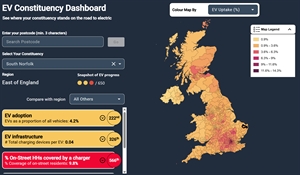
EVA England's latest survey finds that EV drivers are overwhelmingly satisfied with their vehicles, but that those without driveways are facing higher costs, lower confidence and major barriers to switching. The non-profit member association representing electric vehicle drivers also recently published an updated EV Constituency Dashboard, providing a detailed snapshot of how England's local communities are progressing in terms of EV uptake and availability of public charging infrastructure.
EVA England's survey found that there is a widening “charging divide” between UK drivers who can easily charge at home and those who cannot.
While nearly 9 in 10 (87%) of drivers with driveways found their EV “much cheaper” to run compared to a petrol or diesel car, only half (50%) of drivers without a driveway agreed. EVA England says that the gap risks leaving millions of households behind in the country’s transition to electric vehicles.
In total, 1,668 drivers (including some drivers of hybrid, petrol and diesel vehicles) took part from across England and through associated drivers associations in Wales and Northern Ireland. The survey provided a comprehensive snapshot of how drivers are experiencing and perceiving the UK’s EV transition.
EV drivers reported overwhelming satisfaction rates: 95% would recommend an EV to friends and family, and 69% felt the public charging network has improved in the past year. Among petrol and diesel drivers, two-thirds (66%) said they are considering a switch to electric, while 62% of hybrid vehicle drivers said their next purchase would be fully electric.
The survey did reveal some persistent barriers and growing inequalities – particularly as the switch to electric vehicles increasingly reaches concentrated urban environments (where more drivers don’t have off-street parking) and households on lower incomes.
60% of petrol and diesel drivers without off-street parking, for instance, said they would never consider an EV; versus 43% among those with a driveway.
The cost of public charging (averaging 48p per KWh compared to 32p at home; but can be over 80p or as little as 8p on some off-peak tariffs) is a deterrent to those who can't charge at home and a growing source of inequality between drivers in different situations.
EVA England's Chief Executive, Vicky Edmonds, said the findings highlight both progress and a pressing challenge: “Drivers are clearly loving their EVs, but these results highlight a growing inequality that can’t be ignored. Those who can charge at home are saving money and driving the change, while those who can’t are facing higher costs and fewer options. The ‘charging divide’ is now one of the biggest barriers to a fair transition.
"If this transition is to be truly fair, affordable and accessible, it must work for every driver, wherever they live and whatever their circumstances. The driver’s voice needs to be at the centre of how we build the electric future.”
While EVA England's report acknowledges that the Government is taking steps to expand access – including through initiatives such as the £450 million Local EV Infrastructure Fund and a £25 million programme to help councils improve on-street and at-home charging options – it warns that the pace of progress must accelerate.
EVA England has also published an update of its EV Dashboard, which has been developed with support from Zapmap and Field Dynamics. It highlights where public charging rollout lags behind consumer demand. The Dashboard provides a constituency-level breakdown of EV uptake and the availability of public charging infrastructure in each constituency in England.
The first version of the map was released by EVA England two years ago, but the EV landscape has changed significantly since then. EVs now make up nearly a quarter of all new car sales; public chargepoints have grown to more than 86,000; and consumer confidence in the technology has continued to rise.
Stop press: Budget 2025 confirmed that there will be a review of the cost of public EV charging, looking at the impact of energy prices, wider cost contributors, and options for lowering costs for consumers. The review is scheduled to start early next year and last about six months. See this link for more.
Related Links
< Back to news list