COP30 sees significant commitments on renewables and infrastructure but no roadmap for end of fossil fuels
Mon 24 November 2025
View all news
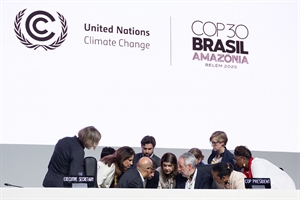
The latest international United Nations Climate Conference (COP30), held in Belem, Brazil, ended with the adoption of an agreed text and some new commitments, but without a clear roadmap for the transition away from fossil fuels. The final text omitted explicit references to coal, oil, or gas phase-out - largely due to opposition from major fossil-fuel producing states.
At least eighty countries that had backed plans to “transition away” from fossil fuels and “reverse deforestation” instead accepted COP30 president André Corrêa do Lago’s compromise proposal of “roadmaps” outside the formal UN regime.
The final package (referred to as the “global mutirão”) reaffirmed global commitment to the goals of the Paris Agreement — limiting global warming to “well below 2 °C” and pursuing efforts to stay below 1.5 °C - acknowledging that the carbon budget consistent with those targets is now “small and rapidly depleted.”
According to Carbon Brief, areas of agreement included a “mechanism” to help ensure a “just transition” globally and a set of measures to track climate-adaptation efforts. COP30 delivered stronger support for vulnerable countries: parties agreed to triple adaptation finance by 2035 and adopted 59 voluntary indicators to track progress under the Global Goal on Adaptation.
For the transport sector, COP30 saw the launch of the Future Fuels for the 4X Pledge under a broader push to scale sustainable fuels globally. The pledge aims to quadruple sustainable fuel use by 2035, with particular attention on hard-to-abate sectors like shipping and aviation — where reliance on fossil fuels remains high. The pledge includes various future fuels like hydrogen and its derivatives, biogases, biofuels, and e-fuels to help replace fossil fuels and decarbonize the energy sector.
Additionally, the broader “Belém Declaration on Global Green Industrialization” and related agreements seek to promote low carbon manufacturing and supply chains, which may benefit the production of zero emission vehicles, sustainable aviation or shipping fuels, and other green transport technologies.
Overall, COP30 reinforced global climate ambition and delivered concrete commitments on adaptation, finance, and a just transition - and it also enshrined sustainable fuels and green industrialization as parts of the climate toolkit. However, the lack of a binding fossil-fuel phase-out roadmap means the transformations remain voluntary and risks of delay remain high.
Image: Courtesy UNFCCC
Related Links
< Back to news list