2025 set to be second or third hottest year on record - exceeding 1.5C heating
Wed 10 December 2025
View all news
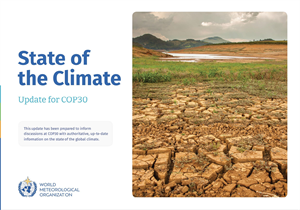
2025 is set to end as the second or third warmest year on record, after 2024, potentially tied with 2023. The global three-year average temperature for 2023-5 is on track to exceed 1.5°C above pre-industrial levels for the first time according to the latest Climate Bulletin from the Copernicus Climate Service. The finding is similar to the WMO's 'State of the Climate' update report, prepared for COP30 in Brazil.
Copernicus, the EU's earth observation programme, says that "the only way to mitigate future rising temperatures is to rapidly reduce greenhouse gas emissions".
November 2025 saw an average surface air temperature of 14.02°C, 0.65°C above the 1991–2020 average for the month. It was 0.20°C cooler than November 2023 – the warmest November on record – and 0.08°C cooler than November 2024, the second warmest. Globally, November 2025 was 1.54°C warmer than the estimated 1850–1900 pre-industrial average.
World leaders committed at the Paris climate agreement in 2015 to keep the planet's heating to less than 1.5C (2.7F) above preindustrial levels by the end of the century. Scientists interpret the temperature target as a 30-year average, so it remains theoretically possible that the target can be met, even if individual months and years breach the threshold.
Since the Paris agreement, emissions have continued to climb, although the expansion of renewable energy has helped to limit the rise. As scientists have predicted this has resulted in higher average temperatures and more extreme weather events.
In a related development, the Arctic has experienced its hottest year since records began. Climate change is triggering cascading impacts from melting glaciers and sea ice to greening landscapes and linked disruptions to global weather. (See associated link.)
Related Links
< Back to news list